Gruppo 25 aprile

Piattaforma civica (e apartitica) per Venezia e la sua laguna

Archivio per la categoria “#UNESCO: Venezia sito in pericolo?”

17 febbraio 17: PandAmonio!

Comunicato stampa (English and Russian versions below)

Venezia, un pesce di nome Panda?

 Quello che comincia domani non è più il nostro Carnevale: è una macchina mangiasoldi per spennare i turisti 11 mesi su 12: il solo mese di tregua per noi è gennaio. Per far girare la macchina mangiasoldi al massimo, bisogna svuotare Venezia dei suoi cittadini e la missione è quasi compiuta. Quasi.. e noi non ci stiamo, non intendiamo rassegnarci a fare le valigie per fare posto a quel tipo di monocultura.

  1. I Veneziani sono una specie in via di estinzione? Anche il panda gigante lo è stato , la buona notizia è che non lo è più.
  2. Simbolo della protezione della natura nel mondo intero, il panda gigante era minacciato di estinzione. Nel 2016, è stato ritirato dalla categoria come specie in “pericolo”, per passare nella categoria di specie “vulnerabile”.
  3. Alla vigilia del Carnevale che non è più nostro, rivendichiamo il diritto di vivere a Venezia, la nostra resistenza alla speculazione che vorrebbe cacciarci da questa città per far posto alla monocultura turistica che tutto vorrebbe inghiottire, la nostra capacità di fornire soluzioni ai problemi sollevati.
  4. Lo facciamo attraverso delle maschere da panda, per attirare l’attenzione del mondo intero. Lo facciamo con un’operazione simbolica oggi alle ore 16 sul sagrato della Chiesa della Madonna della Salute, che fu eretta dai nostri avi quando la popolazione della città precipitò da 143.000 a 98.000 abitanti, con l’epidemia 1630. Oggi siamo rimasti in 54.600 residenti.
  5. Un nuovo slancio è necessario, con la stessa energia che nel 1630 permise alla città di rinascere dopo l’epidemia. Facciamo appello alla solidarietà del mondo intero, perché Venezia, con i suoi abitanti e la sua cultura unica, è patrimonio dell’umanità e non la proprietà privata di qualche lobby.

Il 17 febbraio a partire dalle ore 17 vogliate diffondere queste immagini e i video, vogliate condividerli se condividete il nostro sogno e la nostra battaglia: su facebook oggi saremo in centinaia a farlo, utilizzando l’immagine di profilo che vedete su questa pagina.

#Veneziamiofuturo, 17 febbraio 2017

Contatti:

Marco Gasparinetti +39.345.345.9663

Nicoletta Frosini +39.388.744.4263

Facebook page : https://www.facebook.com/veneziamiofuturo/

Youtube: https://www.youtube.com/channel/UC-sfXhzUreglvd31GpX0jFg

Email: 25aprile2015@gmail.com

Blog : https://gruppo25aprile.org

Twitter : https://twitter.com/25aprileVenezia

Grafica: etra-comunicazione.it

copertina

Press Release:

Venice, a fish called Panda?

That which begins tomorrow is no longer our Carnevale: it is a slot machine for milking the tourists 11 out of 12 months: the only month with a respite for us is January.

In order to get the maximum out of this slot machine, it is necessary to empty Venice of its citizens, and the mission is almost done. Almost… but we who live here are not done; we are here to stay and to stand for our right to remain in our city.

Are Venetians a species destined for extinction? The giant panda also was such, and the good news is that it no longer is. A global symbol of the protection of nature, the giant panda was threatened by extinction. In 2016 it was removed from the category of “endangered species”, to be moved to the “vulnerable” category.

On the eve of a Carnevale that is no longer ours, we reclaim:

our right to live in Venice;

our resistance to the speculation that would chase us from our city to make way for the slot machine that wants to swallow all;

our capacity to offer solutions to the growing problems (see attachment).

We do this with panda masks, to attract the attention of the whole world. We do this today at 4m Venice time at the steps of the Church of the Madonna della Salute, which was erected by our forebears when the population of the city dropped from 143.000 to 98.000 inhabitants in 1630. Today there are only 54,600 residents left.

A new surge is needed, with the same energy that in 1630 enabled the city to be reborn after the plague. We appeal to the solidarity of the whole world, because Venice, with its inhabitants and its unique culture, is the heritage of all humanity, and not the private property of a few interests.

We ask you to share these images and videos; we want you to share them if you share our dream and our fight. Today we will be hundreds and may be thousands to do it, in front of the Church and on Facebook.

#Venicemyfuture, February 17, 2017

Translation by: Paul Rosenberg

Contact points:

Marco Gasparinetti +39.345.345.9663

Nicoletta Frosini +39.388.744.4263

Facebook page : https://www.facebook.com/veneziamiofuturo/

Blog : https://gruppo25aprile.org

Twitter : https://twitter.com/25aprileVenezia

Youtube: https://www.youtube.com/channel/UC-sfXhzUreglvd31GpX0jFg

Email: 25aprile2015@gmail.com

Grafica: etra-comunicazione.it

copertina

  • Карнавал, который начнется завтра – это больше не наш Карнавал, это машина для зарабатывания денег, игральный автомат для того чтобы обирать туристов 11 месяцев в году из 12. Единственный месяц передышки для нас – это январь.
  • Чтобы заставить работать по полной этот игральный автомат, необходимо опустошить Венецию, изгнав ее жителей, и тогда миссия почти завершена

Почти… вот только мы не согласны!

  • Венецианцы – это вымирающий вид? Большая панда тоже была вымирающим видом, но хорошая новость заключается в том, что больше она таковым не является.
  • Символ защиты природы во всем мире, панда, находилась под угрозой вымирания. В 2016 году её исключили из категории видов, находящихся в опасности, и определили в категорию уязвимых.
  • Накануне Карнавала, который больше не является нашим, мы отстаиваем свое право жить в Венеции, мы сопротивляемся тому чтобы быть изгнанными из нашего города, тому чтобы освободить место для этого автомата по выкачке денег, который хочет поглотить всё! Мы говорим о нашей способности предоставить решение изложенных выше проблем (см.приложение).
  • Мы заявим это с помощью масок панды, чтобы привлечь внимание всего мира к данной проблеме. Действие будет проходить на площади перед церковью Madonna della Salute, которая была возведена нашими предками, когда количество жителей резко сократилось со 143.000 до 98.000 , в 1630 году.
  • Необходим новый подъём, с такой же энергией как в 1630 году, который позволил городу возродиться после эпидемии.
  • Мы обращаемся ко всему миру за солидарностью, потому что Венеция, со своими жителями и своей уникальной культурой, является наследием всего человечества, а не частной собственностью неких лобби.

Пожалуйста, распространите эти фотографии и видео, поделитесь ими, если разделяете нашу мечту и нашу борьбу.

#Veneziamiofuturo,17 февраля 2017

copertina

Contact points:

Marco Gasparinetti +39.345.345.9663

Nicoletta Frosini +39.388.744.4263

Facebook page : https://www.facebook.com/veneziamiofuturo/

Blog : https://gruppo25aprile.org

Twitter : https://twitter.com/25aprileVenezia

Youtube: https://www.youtube.com/channel/UC-sfXhzUreglvd31GpX0jFg

Email: 25aprile2015@gmail.com

Grafica: etra-comunicazione.it

copertina

Ateneo Veneto, 20 January 2017

#Veneziamiofuturo

The Proposals of the Sestieri

Traduzione della versione italiana già pubblicata a questo indirizzo:

20 gennaio, le 20 proposte dei sestieri

Introduction:

This document summarizes the proposals and the principal requests collected in the meetings with the venetian districts (the six “sestieri”). It is not exhaustive, nor does it represent the position of a single association because our objective is to give voice to the needs of the districts with reference to the problems most acutely felt in the ‘city of water’. In this sense it is also a ‘book of grievances’, where for each ‘grievance’ we have elaborated a possible response.

The proposals conform to the criteria which were specified at the beginning of the cycle of meetings: we are not asking for the moon, we do not want to create illusions or engage in demagoguery; the criteria by which we are inspired are those which translate to requests that are concrete, actionable and realistic. To the elected representatives in the Institutions we ask that each one do their part, and that they do it immediately, because Venice feels besieged and the situation does not allow for any further delay.

The discussion at Ateneo Veneto will permit discussion of some “priority” proposals, and to refine others, situating them in a vision of that which is necessary and urgent to give a future to Venice: we will not speak of long term but of things that can be done immediately, before it is too late; the rest is material for a ‘program of governance’ for anyone who wants to run for office in the next election. This document was published for 10 days on our Facebook page and on our web site to collect comments and suggestions from those who participated in the meetings (over 500 people) and also those who did not.

The cycle of meetings in the sestieri, including the concluding meeting at Ateneo Veneto, was entirely self-financed by the citizens, without any support from political parties or trade unions, businesses or cooperatives, public entities or Foundations. We do not have a label and we do not want one, ours is only a movement of opinion that has preferred a different approach from the ‘recipes’ that come from on high (often formulated by people who do not know the city): proposals born of daily contact with the city, sestiere by sestiere.

A as in Alloggi (Housing)

Of the Veneto Region we ask:

1) the urgent modification of the regional law of 2013 that brutally liberalized tourist locations; this modification could be adopted in a short time because it would only require the introduction of an exception for the sestieri of Venice, in recognition of the specific needs to care for its social fabric, which is an integral part of what makes it special, imposing requirements also on the disposal of waste water, to care for the hygiene and environment of the Lagoon.

2) immediate action regarding ATER (the social housing company) whose job is “the construction and recovery of housing, to assign as temporary or permanent lease to controlled apartments” to the end of the assignment of housing currently not used, eventually favoring a form of self-restore done by potential residents, and to the completion of housing units where work has been started but not yet finished.

B as in Bricole (Guide Posts for water traffic):

Of the Minister of Infrastructure and Transport we ask:

The allocation of funds needed to start a special program for the maintenance and replacement of the bricole, to complete the first work of the InterRegional Superintendent for Public Works, based on the maps which were updated at our request in May 2016.

C as in Change of use:

Of the Mayor and City Council of Venice we ask:

To immediately stop for at least two years the change in use of real estate from residential to tourist lodgings or hotels in the sestieri, an option which is already recognized by the current PAT (Plan for Territorial Assests) in force since 2014 to protect residential property, which has fallen to historic lows and in some sestieri risks being extinguished in the absence of immediate ‘shock therapy’.

This provision, by nature emergent and provisory, will be accompanied by ‘structural’ measures and permanent times to incentivize long term residence over that of a speculative nature (see also R for refuse, on the subject of TARI for the use of fiscal levers as equalizers): that which will be assembled is a mix of measure such as will build a common pact with ‘virtuous’ property owners.

D as in Dignity

Of the Mayor and City Council of Venice we ask:

To recognize and promote the right of each person to conduct an existence that is dignified and decorous. Respect for the old and the disabled cannot be limited to some ‘reserved’ seating on board the vaporetti, but must manifest in forms of support aimed at sustaining the quality of life for this sector of the citizenry.

In these sectors the City of Venice boasts a solid tradition that we maintain is necessary to preserve or restore against the spending cuts that have been made, also encouraging the numerous forms of volunteerism present in the area that often operated without any public contribution.

E as in Education (Nautical)

To the city schools we propose:

A project of nautical education, to which we are ready to provide our contribution with volunteer teachers and experts, in consideration of the increasingly frequent accidents (at times fatal) that are in part due to inexperience and/or a lack of understanding of the basic rules, given that the current law allows navigation without a license for motorboats under 40 hp (that with simple modifications can be brought up to 60).

F as in Flow of Tourists

Of the Mayor and City Council of Venice we ask:

To start as soon as possible some form of planned management of the flow of tourists that would permit a loosening of the grip of a pressure that has become unsustainable and incompatible with the very possibility of offering a welcome worthy of the City’s reputation; among the proposals on the table, that of Roberta Bartoloni which was illustrated at the meeting in Castello presents characteristics of being incremental, flexible, achievable, and non-discriminatory, while containing costs, which we particularly appreciated – without excluding others that can be compared with this one, to the end of taking the best parts of each.

G as in Gestione dei beni comuni (Management of Public Property)

Of the Mayor and City Council of Venice we ask:

To give a tangible sign of discontinuing the policy of selling off public properties begun by previous administrations, which in the current budget situation (with the loosening of the restrictions of the stability pact) is incomprehensible if not myopic, and in some cases translates in to an absolutely paltry amount of revenue relative to the permanent loss for the community as has happened with custody of the Giardini Papadopoli.

H as in Hotels

3) Enough hotels in the Sestieri! See C for Change of Use

I as in Illumination:

Of the Administration and City Offices in charge we ask:

Night lights and the installation of surveillance cameras in ruga degli Oresi, which recently has seen incidents of terrible violence against a store owner.

L as in Labor

Considering that the tourist industry at Venice is already that which employs the largest number of workers, often temporary and poorly paid in respect to the cost of life [1], with the double consequence of commuting from the mainland (about 30,000 people) and of an ever larger number of young Venetians who choose to leave the city [2]

Of the Mayor and City Council of Venice we ask:

To move beyond the current phase of using the Arsenale as a space for private parties –the proceeds from which are not being used, as would be logical, to address the many maintenance problems that become emergences ignored by the Administration (such as risks of collapse) –  when instead it should be a natural point and ideal fulcrum for the creation of qualified jobs, that are not related only to the tourist monoculture – this could be designed as a center of maritime research able to host research institutions both Italian and foreign and offering spaces to businesses compatible with the complex and engaged in the maritime sector (shipbuilding, maritime jobs), traditional artisanry (metalwork, woodwork) and restoration, in a cultural framework unique in the world. To respect the promise of ‘revitalization of the city’ we further ask for the opening of the Arsenale to the citizens, breaking down the barriers to permit a unique tour for visitors (also in the spaces occupied by the Biennial) which could generate income with paid guided tours for small groups.

[1] Unioncamere data: 77% of jobs created in the City of Venice in 2016 were temporary. More than half of the job offers (4,350 of 8,000) were in hospitality or restaurants. In second place (3,600) were ‘unqualified’ positions in retail and services. Source: Nuova Venezia 8 November 2016

[2] Venetians permanently residing outside the city as of December 2016 (source: electoral lists from the constitutional referendum): 12, 296, more than the combined number of residents in the sestieri of both San Marco and San Polo!

M as in Museo Correr

To the Foundation of Civic Museums we remind:

The Museo Correr , a fundamental institution in the cultural life of the city, owes its name to its founder, Teodoro Correr: a Venetian nobleman who in the years following the fall of the Republic was able to collect an enormous quantity of artistic works and Venetian heirlooms from many time periods, saving them from dispersion and constituting the nucleus of the museum. Thanks to later important donations and acquisitions, such as that of articles belonging to Doge Francesco Morosini, given by the City of Venice at the end of the 1800s, the Museo Correr has grown ever more robust and has become an important point for reference for academics and citizens. In 1922 the collections were transferred to Piazza San Marco in a new home that extends between the Napoleon Hall and part of the New Procuatory. Together with the Doge’s Palace it constitutes (or should constitute) the main exhibition of works of art and historical collections that recall the history and culture of La Serenissima. Unfortunately the radical changes of the past years show that renovations and repairs, while correct from a formal point of view, can alter the aims and characteristics of an institution.

The citizens have the sense that the value of the more original and fundamental aspects of the history and culture of Venice has been lost sight of in favor of other, more historically marginal subjects.

To the Foundation of Civic Museums we therefore ask:

To return to the spirit and the logics  that are at the heart of the origin of the collections of the Museo Correr, recalling also that the recovery of dignity and of understanding of the city comes not only from a greater attention to its history and to its people and culture, but also from a use that is not only for tourists and commercialization of its symbolic monuments, and underlining  how a  ‘quality tourism’, that it is said is desired to be cultivated, in reality involves  understanding the history and the specific characteristics  of a maritime Republic unique in the world, more than finding the types of things one can find in any other museum also here.

N as in Negozio (Stores: local businesses and artisan shops)

Adoption of a city Regulation that, as the City of Florence has already done, fixes a limit on the proliferation of commercial activity incompatible with the protection of the city’s heritage, both physical and non-material (local artisans), taking advantage of provisions of law recently adopted at the national level with the objective of prioritizing local stores and artisanal activity; for such activity we further ask to identify methods of financial aids and incentives compatible with the rule “di minimis” (within the threshold of 200,000 euro per capita, which avoids the obligation of notification to the European Commission).

O as in Ospedale (Hospital)

An innovative and promising proposal that we have received is that of connecting our hospital with the University of Padova and to bring to Venice trainees and doctoral students. Developing this pairing with the University of Padova, Venice could become a site of advanced medical research, setting up in the large and free spaces of the Convent of the Domenicani (now the Civic Hospital) a world class center of health studies, as has already been done at Trieste with SISSA.

In the way the almost spaces of San Domenico would be put to better use, and would avoid speculative works related to tourism. In these locations one could develop clinical work and research, for innovative cures of absolute excellence. This would make our Hospital a point of attraction and would revitalize all the surrounding area.

To the Minister of Health we ask:

The maintenance of the neonatal unit in the Civic Hospital of Venice, in exception of the limit of 500 births per year, in consideration of the travel times and modes of transport available in the Lagoon city, as has already been requested of the Region.

P as in Posts for Boat Moorings

Of the Mayor of Venice we ask:

To release the announcement to assign the empty boat mooring spaces in the sestieri and the islands, that the city offices prepared over a year ago for then Commissioner Zappalorto and is now an obligation that has been ignored by the current Administration, given that the applicable city ordinance calls for this announcement every 2 years.

Q as in Quality of Air

Of the Veneto Region we ask:

Immediate action regarding the Regional Agency for the Environment (ARPAV) in order that they finally install an air quality monitoring station in the sestieri, considering that the only sampling point present in the Lagoon was located at Sacca Fisola long ago when the circumstances were different than at present, it is not representative of the real exposure of the resident population such that it is classified as a ‘background station’ and does not measure the impact of local sources of pollution, such as water traffic.

A plan for the fixing or scrapping of the most polluting marine engines, making use of ‘structural’ European Union funding for regional projects, or EU funds such as Life+.

R as in Refuse

Of the City Council of Venice we ask:

Reform of the city taxes such as TARI (Tax on Urban Waste) with a reduction to zero for the first house and a reduced rate for general domestic use; in the short term, immediately revoke the rate increases approved by the City Council for 2016, and finance with a rate increase applied to hotels and other tourism related buildings.

S as in Schools

Of the Mayor and City Council of Venice we ask:

A renewed support for the development of nursery schools and kindergartens, which represent a fundamental service for the citizens and that have always been the pride of the City of Venice. This means strategic activity aimed at providing an excellent level of education for children and providing important support, especially for those families in which both parents work. It seems logical to ask that, also for the future, the City commits to guaranteeing an adequate quality of life and security for children and their families, as well as to those who work in the sector.

T as in Traffic (on the water)

Of the Mayor and City Council of Venice we ask:

Elaboration and activation of a plan for the reorganization of water traffic that puts as primary objectives: the safeguarding of the heritage of buildings public and private against the effects of motorboat waves; monitoring of atmospheric pollution; monitoring of sound pollution; the security of navigation of public scheduled transports, including gondolas and ferries; the right of residents to circulate with their own boats in the internal canals and a more rational approach to the transport of merchandise which is actually characterized by iron boats that are disproportionate to both the need and to the internal canals themselves.

U as in ‘Ultima Spiaggia’ (Last Chance)

In the absence of an immediate, drastic remedy on the dual fronts of housing and work, the demographic curve in the sestieri is such that the ‘surviving’ residents of Venice are condemned to irrelevance by a cynical and myopic political class (to say the least) that reasons only with numbers and ‘how many votes gained’ from this or that community, not only at the regional level (in fact there is no regional council) but also in our own city: from the Administration in power the accumulated signs in this sense are already too great to ignore.

Of the Veneto Region we ask:

Call a referendum of popular initiative for the re-establishment of two autonomous cities (Venice and Mestre) for which 9,000 signatures have already been gathered, in such a way that the population can express themselves on the merit of the question, that the institution of the Metropolitan City of Venice permits to be addressed in a way different than in the past and considering that the current Mayor has recalled the delegates from the Municipalities, and in doing so has weakened the already feeble appearance of administrative decentralization.

Considering the imminent call for a referendum on regional autonomy, the pairing of the two referendums would allow overcoming the objections relative to the costs of a referendum that regards the territory of the City of Venice.

Of the Italian Authorities we ask:

The recognition of a Special Status for Venice, which permits the city to: A) keep a portion of the revenue generated, rather than begging for money periodically, and which is in reality owed to the city if one considers the accumulated fiscal residuals (the difference between taxes collected in the territory and the sum of transfers and services received by the State); B) decide autonomously what the priorities for action are in the territory, without being sacrificed on the altar of electoral numbers that do not take in to account the universal value of Venice, its special traits which are unique to the world, and its status as World Heritage.

V as in Venice – in the open

Among the requests that we have collected in the sestieri are also:

  1. Bring back the open air cinema at Campo San Polo.
  2. Double the frequency of the Santa Marta Flea Market, which is particularly valued by residents.
  3. The restoration of the antique and collectible stores, denoted as “Mercantini dei Miracoli’, eliminating the tariff of 50% for professional vendors which has been responsible for their disappearance.
  4. Maintenance and repair for public fountains and more generally to all the things that are city property in public spaces (benches, fountains and signs) that at times are found in a state of incomprehensible abandonment.
  5. Facilities for sports and athletic activities are scarce; we lack, for example, a facility for promoting youth athletics. We ask the City to guarantee a complete offering of sports activities, starting with better use of existing facilities.

This document will be sent to mass media and to the participants at the public meeting on Jan. 20, and will then be published on the Venziamiofuturo Facebook page and on the web page www.gruppo25aprile.org.

Venezia e UNESCO: la rassegna stampa

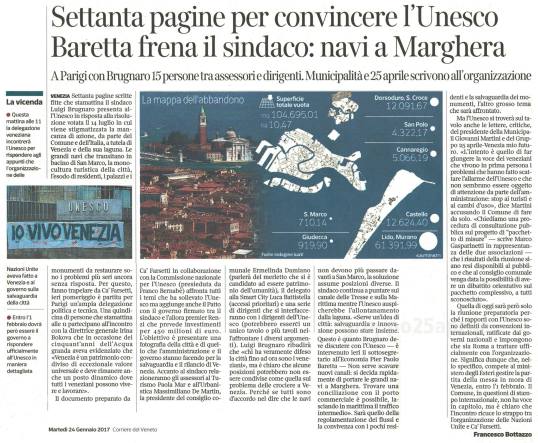
Nuova Venezia, articolo Vera Mantengoli con richiamo in prima pagina:

24-gennaio-vera


24-gennaio-17

Nuova Venezia, articolo Alberto Vitucci:

24-gennaiovitucci

Gazzettino, articolo Giorgia Pradolin:

24-gennaio-giorgia

Corriere, articolo Francesco Bottazzo:

corriere


Lettera aperta di una cittadina francese

Le maire de Venise, Brugnaro, vient discuter ou défendre sa ville auprès d’Irina Bokova, directrice générale de l’Unesco, rue Miollis à Paris. L’Unesco, vous le savez, a menacé Venise d’être inscrite sur la liste des “Sites Mondiaux de l’Humanité EN PERIL” avec dead-line au 1er février 2017 pour des propositions de sauvegarde.
Peut être avez vous suivi le travail de l’association Gruppo 25 aprile et de celle plus récente, VeneziaMioFuturo, en réponse à une phrase du maire prétendant que la vraie Venise actuelle était à Mestre, où résident tous les travailleurs et les vénitiens chassés par les trafics de location AirBnb, les ventes aux chinois et le tourisme de masse, bref de putatifs électeurs.
Cette protestation avait donné lieu à un flash mob où, ds qq villes d’Europe- dont Paris depuis le Sacré Coeur- et du monde comme à des milliers de fenêtres vénitiennes, était apparues des banderoles bleu, vert et blanc “Venezia mio futuro/Venice my future”) l’été dernier, puis à l’automne une manifestation très suivie vers le Rialto, tout carrossello dehors et encore une autre valises en main dénonçant l’exil des vénitiens du Centre historique. Vous avez bien sur eu vent de celles organisées par No Grandi Navi contre ces géants qui naviguent dangereusement le canal de la Giudecca.
Plus que de protester, ces citoyens se sont réunis par quartiers depuis l’annonce de l’Unesco, l’été dernier .En sont sorties des propositions réalisables et constructives qui, sans résoudre tout, permettraient aux résidents du centre historique et de la lagune, de vivre sereinement. Il en a été publié en pleine page un résumé très bien conçu. Nous avons tous tweetté à l’Unesco et à mme Bokova ce document.
En effet, la Mairie avait promis un dialogue avec les vénitiens, ce qui n’a pas eu lieu malgré les annonces de réunion par quartier (“sestieri”) qui ont été largement relayées par les réseaux sociaux. Sans réponse ou prise de contact, les citoyens ont continué leur réflexion et présentent aujourd’hui ces propositions à la fois à la municipalité et à Madame Bokova afin qu’elle en tienne compte, en parallèle de celles du Maire et de son équipe, inconnues de tous. Ce dernier n’a trouvé jusqu’à présent que de protester de l’effet négatif sur l’économie de la cité et de son image ainsi que de l’absence de soutient de Rome. Il est vrai, vous le savez, que Venise relève d’une Loi spéciale qui en rattache les plus importantes décisions et les subventions au gouvernement national à Rome et en ce moment…
Je ne sais ce que vous pourrez tirer de ces informations pour souligner l’action de ces associations apolitiques et citoyennes au regard de cette visite à l’Unesco du Maire de Venise. Mais les vénitiens sont peu nombreux, armés de leur seul courage et ont besoin d’être soutenus par tous ceux qui aiment leur cité et la lagune ds sa réelle authenticité. Et les français sont les plus fidèles à ce lieu magique.
Voici la page du blog de Gruppo 25 aprile
Votre appui nous serait précieux et si vous vouliez bien vous en faire l’écho auprès de vos confrères afin que cette action remarquable ne reste pas lettre morte, que monsieur Brugnaro sente le vent souffler et que si nul n’est prophète en son pays, ceux qui l’aiment puissent aussi faire une amicale pression.
Sophie Caroline Maningue de Chanaud
flash1
Photo: Isabelle Kahna

Breaking News: Breakfast in Paris, la nostra lettera all’UNESCO

Cronaca semiseria:

..e lettera seria, alla Direttrice Generale dell’UNESCO, Irina Bokova:

Oggetto: Vostro incontro con il sindaco di Venezia, con riferimento alla decisione 40 COM 7B.52 del 14 Luglio 2016.

Apprendiamo dai giornali locali che il 24 gennaio incontrerete un sindaco che ha finora declinato gli inviti ad informare il Consiglio Comunale (19 gennaio), i media e i suoi stessi cittadini (20 gennaio) sui contenuti del “pacchetto” di misure che presenterà a voi, attraverso il governo italiano, in risposta alla Decisione del World Heritage Committee (Comitato del Patrimonio Mondiale dell´Umanità) 40 COM 7B.52 adottata nella 40a sessione a Istanbul il 14 luglio 2016 su Venezia e la sua Laguna (d’ora in poi: “Decisione UNESCO”).

Secondo le dichiarazioni del sindaco ai giornali, il suo progetto in risposta al punto 6 della Decisione UNESCO consisterebbe nello scavo di un nuovo canale in mezzo alla Laguna (Canale delle Tresse) per le navi da crociera più grandi. Tuttavia, nessuno conosce i dettagli di tale progetto, che non è nemmeno stato sottoposto a valutazione di impatto ambientale; inoltre, non sono al momento noti gli elementi di risposta ai punti da 7 a 10 della Decisione Unesco.

Secondo la dichiarazione del sindaco, il “pacchetto” dovrebbe includere anche misure rispondenti ai punti 4 e 5 della Decisione UNESCO, per le quali però (ammesso che davvero esistano, anche in bozza) non è mai stata organizzata alcuna consultazione pubblica, né è stato sentito il Consiglio comunale, nonostante alcune misure (come la pianificazione urbana) appartengano proprio alla competenza esclusiva del Consiglio Comunale.

Inoltre, una “strategia integrata per tutti gli sviluppi in corso e pianificati” è ancora mancante, nonostante il punto 4 della Decisione UNESCO richieda una “revisione dell´approccio di pianificazione, fondato su una visione condivisa da parte delle autorità e di tutte le parti interessate”. Tuttavia, su tale “pacchetto” le parti interessate non sono mai state consultate, né alcuna informazione è mai stata data al pubblico, nonostante l’invito del 28 dicembre 2016 indirizzato al Sindaco (allegato 1), il quale ha declinato l’invito via e-mail, il 18 Gennaio 2017.

Rispettosamente sosteniamo che, così facendo, il Sindaco di Venezia probabilmente:

1. Non riuscirà a rispettare le disposizioni della Convenzione di Aarhus, ratificata dall’Italia con legge del Parlamento 108 del 16 marzo 2001. Come Lei sa, la Convenzione UNECE firmata ad Aarhus conferisce alla società civile il diritto di partecipazione effettiva ai processi decisionali riguardo a tutti i fattori che incidano o possano incidere sull’ambiente.

2. Non sarà in grado di rispondere alla Decisione UNESCO in tutti i suoi punti, fatta salva una riserva d’esame del “pacchetto di misure” che nessuno, a parte il Sindaco, sembra conoscere fino ad ora.

Supponendo che l’incontro si tenga veramente il 24 gennaio e che un “pacchetto di misure” esista davvero, almeno come prima bozza, in base alla Convenzione di Aarhus e al punto 4 della Decisione UNESCO del 14 LUG 2016, chiediamo che:

1. una procedura di consultazione pubblica sul progetto di “pacchetto di misure” venga immediatamente avviata;

2. i risultati della riunione del 24 gennaio siano resi disponibili al pubblico attraverso i mezzi opportuni, compreso il web streaming se appropriato;

3. al Consiglio Comunale venga data la possibilità di avere un dibattito orientativo sul pacchetto complessivo, che è totalmente sconosciuto ai consiglieri comunali.

Per quanto ci riguarda, consideriamo la Decisione UNESCO un atto di grande importanza, tanto da avere attivato, con grande investimento di tempo e di energie e senza alcun finanziamento pubblico, un percorso di partecipazione pubblica dal nome “Venezia mio futuro”, che si è tradotto in 6 incontri pubblici in 6 mesi, sestiere per sestiere, culminato nell’incontro finale del 20 gennaio, a cui il Sindaco è stato invitato con largo anticipo (ma ha declinato l’invito).

Il risultato di questo percorso è un documento con 20 proposte che è stato sottoposto a consultazione pubblica per 10 giorni, e discusso all’Ateneo Veneto il 20 gennaio; la sua versione finale è allegata alla presente (allegato 2). Per una migliore comprensione di ciò che “partecipazione” significhi per i cittadini veneziani, si allegano alcuni ritagli di stampa, che danno un’idea di quello che ci aspetteremmo da un sindaco: il riconoscimento del nostro diritto alla partecipazione, sancito dallo Statuto Comunale di Venezia, così come dalla Convenzione di Aarhus.

Rimaniamo a disposizione per qualsiasi ulteriore informazione, con riserva di rivolgerci ai tribunali nazionali competenti e/o al Comitato di Controllo della Convenzione di Aarhus (Aarhus Convention Compliance Committee) nel caso in cui il nostro appello non trovi ascolto.

Venezia, 23 gennaio 2017


#Veneziamiofuturo ringrazia:

Isabella Da Re, Isabelle Kahna, Laura Antonietto, Loup Bosch y Palmer, Franca Simoli, Paolo Valdisserri e Anna Ferrigno per la “vela” che ha fatto rotta su Parigi;

Paola Minoia per la traduzione dall’inglese all’italiano;

John Casabase per il video.

Paris, bonjour! Lettera e flashmob all’UNESCO

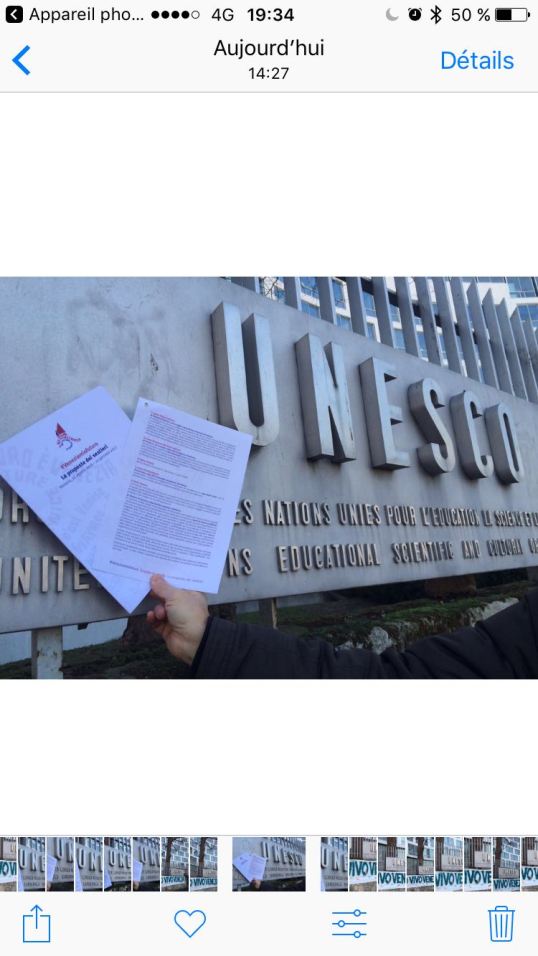
Lo striscione da 4 metri lo conoscete: è quello che adornava il tavolo degli oratori venerdì, all’incontro conclusivo di #Veneziamiofuturo. Si è fatto un migliaio di chilometri per arrivare fin qui, al quartier generale dell’UNESCO che domani si appresta a ricevere la visita del Sindaco di Venezia:

img-20170122-wa0016

“Il est 5 heures, Paris s’éveille”.. avec des poissons venitiens!

I nostri pesciolini da Parigi salutano la mamma Anna Ferrigno ma non sono l’unica sorpresa: l’UNESCO oggi riceverà anche la lettera che qui trascriviamo, in cui viene denunciato il rischio di una violazione della Convenzione di Aarhus se veramente il “pacchetto di misure” annunciato alla stampa verrà presentato dal Sindaco senza alcuna forma di pubblica consultazione, che la Convenzione ratificata con Legge dello Stato nel 2001 ha reso obbligatoria anche in Italia.

Se invece il Sindaco ci va a mani vuote o per “sondare il terreno” vuol dire che il suo viaggio a Parigi potrà essere interpretato come una simpatica visita di cortesia che potrebbe anche avere un senso sempre che non si porti venti persone al seguito, dato che a pagarne il viaggio saremmo noi.

In entrambi i casi, la richiesta dei cittadini è semplice: essere informati sulle misure concrete che il Sindaco intende presentare all’UNESCO, dato che nemmeno il Consiglio comunale riunitosi il 19 gennaio lo è stato e per le “uova pasquali con sorpresina” è ancora presto, siamo solo a gennaio.

Diversamente dalle sue, le nostre proposte sono in rete dal 10 gennaio e sono il frutto di una consultazione pubblica; nella stesura definitiva distribuita all’Ateneo Veneto verranno pertanto depositate oggi all’UNESCO insieme con questa lettera:

♡♡♡♡♡♡♡♡♡♡♡

Venice, 23 January 2017

Subject: Your meeting with the City Mayor of Venice, regarding Decision 40 COM 7B.52 of 14 July 2016.

According to the local newspapers, on 24 January you will meet a City Mayor who has until now declined all invitations to inform the City Council (on 19 January), the mass media and his own citizens (on 20 January) about the content of the “package” of measures that he will submit to you, via the Italian Government, with a view to addressing the World Heritage Committee Decision 40 COM 7B.52 adopted at its 40th session in Istanbul on 14 July 2016 on Venice and its Lagoon (hereinafter: “the UNESCO Decision).

According to the City Mayor’s statements to the newspapers, his own project to address point 6 of the UNESCO Decision would consist in the dredging of a new deep canal in the middle of the Lagoon (“canale delle Tresse”) for the largest cruise ships. However, nobody knows the details of such project, which has not even been submitted to EIA, and no follow-up was given until now to points 7 to 10 of the UNESCO Decision as far as we know.

According to the City Mayor’s statement, the “package” should also include measures addressing points 4 and 5 of the above referred Decision, but none of them (assuming that they really exist at preliminary draft stage) has ever been submitted to public consultation nor to the City Council (Consiglio comunale), while some of them (such as urban planning) belong precisely to the exclusive competence of the City Council. Moreover, the “integrated strategy for all ongoing and planned developments” is still missing while point 4 of the Decision requires a “revised planning approach founded on a shared vision of authorities and stakeholders”. The stakeholders have never been consulted on the above package of measures and no information was ever given to the public despite the attached invitation addressed on 28 December 2016 to the City Mayor (annex 1) who declined the invitation by email of 18 January 2017.

We respectfully submit that by so doing the City Mayor is probably:

1. Failing to comply with the provisions of the Aarhus Convention, ratified by Italy with Act of Parliament 108 of 16 March 20o1. As you know, the UNECE Convention signed in Aarhus empowers the civil society with the right to participate effectively in decision-making on all factors affecting or likely to affect the environment.

2. Failing to comply with the UNESCO Decision on all points, subject to a scrutiny reservation of the “package of measures” that nobody but the City Mayor seems to know.

Assuming that the meeting will really take place on 24 January and assuming that a “package of measures” really exists at least at a draft stage, compliance with the Aarhus Convention in conjunction with point 4 of the UNESCO Decision of 14 July 2016 would in our opinion require that:

1. A public consultation procedure is immediately launched on the draft package of measures;

2. The results of the meeting of 24 January are made available to the public via the appropriate means, including web streaming where appropriate;

3. The City Council is given a chance to have an orientation debate on the overall package, which is totally unknown to its members.

As far as we are concerned, we have taken the UNESCO Decision so seriously that, with very significant investment in time and energies and without any public funding we have launched a public participation process called “Venice my Future” which resulted in 6 public hearings and meetings in 6 months in each and every venetian district (the 6 “sestieri”) and culminated in the final gathering of 20 January to which the City Mayor was invited well in advance (but declined the invitation).

The result of this process is a document with 20 proposals which was submitted to public consultation for 10 days, and discussed at the “Ateneo Veneto” on 20 January;  its final version is herewith attached (annex 2).  For a better understanding of what “participation” means to venetian citizens, please also find attached some press cuts which give a hint of what we would expect from a City Mayor: the recognition of our right to participate, which is enshrined in the “Statuto comunale” of Venice as well as in the Aarhus Convention.

We remain at your disposal for any further information while reserving our right to lodge a complaint with the domestic competent Courts and/or with the Aarhus Convention Compliance Committee in case our voice is not heard.

♡♡♡♡♡♡♡♡

Firmato: settimo sestiere, quello che arriva quando nessuno se lo aspetta.. come il settimo cavalleggeri.

Venezia – Parigi, 23 gennaio 2017

2016, un anno in sintesi. Seconda parte: un luglio caldissimo!

Semestre molto intenso, farne una sintesi non è cosa facile e per renderla più “agile” l’abbiamo divisa in più parti; per chi non avrà il tempo o la voglia di leggerci c’è un piccolo “cammeo” natalizio, sul canale youtube inaugurato proprio il 2 luglio 2016:

Dunque, alla fine della prima parte ci eravamo lasciati con il mese di giugno quando nel silenzio più assoluto preparavamo l’operazione a sorpresa che il 2 luglio avrebbe addobbato finestre e balconi delle nostre case, statue e ponti di Venezia, otto istituti scolastici superiori e pure un vaporetto in corsa! A futura memoria, la mappa di case, scuole e “statue parlanti” del 2 luglio era questa:

2-luglio-2017-mappa

Riassumere l’enormità del lavoro fatto in quelle settimane è quasi impossibile: per farlo ci vorrebbe un libro (un giorno chissà..) ma per ripercorrere a ritroso la macchina del tempo di #Veneziamiofuturo potete utilizzare questo link (che permette di ritrovare anche le foto del “backstage” e il segreto di fabbricazione dei nizioi):

https://gruppo25aprile.org/category/veneziamiofuturo/

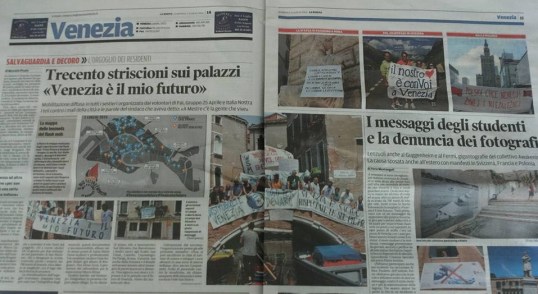
2-luglio-2017-nv

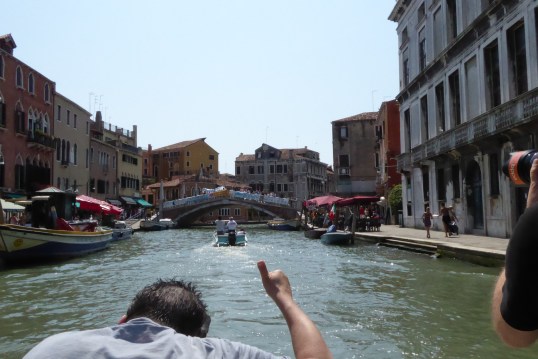
Per poter effettuare le riprese rispettando i limiti di velocità, avevamo organizzato una piccola “flotta” di cinque imbarcazioni che seguendo percorsi diversi hanno coperto tutti i sestieri, ed il momento è arrivato per ringraziare le persone che ne hanno preso i comandi: Dario, Lillo, Giulia, Fabio e Giorgio!

2-lulglio-2017-barche

Ad effettuare le riprese video e fotografiche, distribuiti sulle varie barche, una squadra eccezionale: Stefano Soffiato, Philippe Apatie, Marco Secchi, Alessandro “Bibi” Bozzato, Althea Pauletto. Dietro le quinte, una batteria di lancio per fare in modo che le immagini arrivassero anche nelle redazioni.

bibi

Per le riprese dei “nizioi” che non erano visibili dai canali, i nostri “fanti da mar” Loredana Spadon e Max Vianello hanno percorso chilometri di ponti, calli e campielli alla ricerca dei più nascosti.

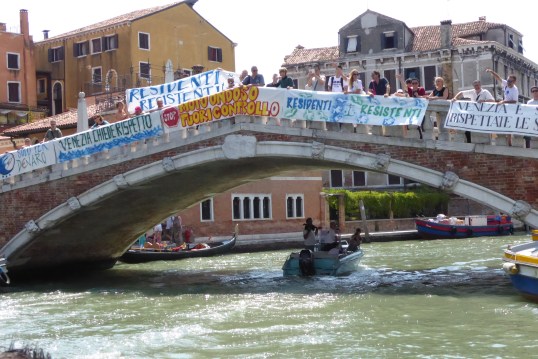
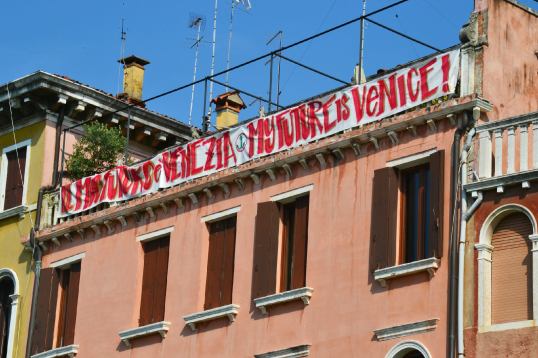
Risultato? All’ora di pranzo, le redazioni di giornali e telegiornali avevano già ricevuto decine e decine di immagini come queste. Non una sfilata di bandiere tutte uguali, ma tele di stoffa tagliate su misura ( i nostri “nizioi”) con parole d’ordine declinate e decorate secondo la sensibilità individuale di ognuno di noi, che coprivano tutti i sestieri e le tipologie di case: dagli 80 centimetri delle finestre più piccole ai 12 metri di certi balconi sul Canal Grande, è stato un lavoro da “sartoria” artigianale.

balcone

Althea 2.jpg

althea-8

Simultaneamente, analoghe foto cominciano a piovere sui tavoli delle redazioni da Parigi e da Varsavia, dal Brasile e dalla Svizzera dove sventolano lenzuola prodotte “in loco”, e le scuole di Venezia si presentano cosi:

Althea 16

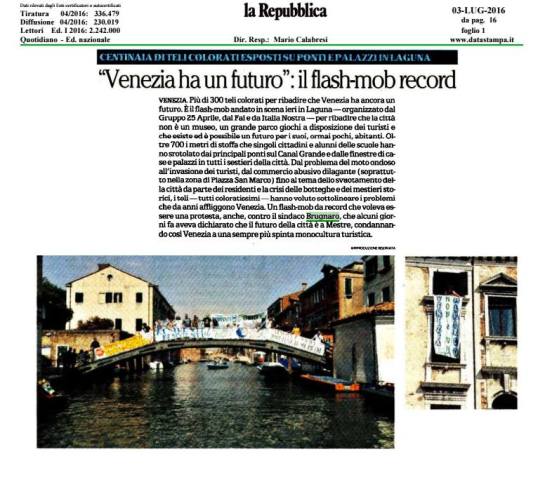
Senza pubblicità sui giornali, senza proclami su facebook, senza partiti né sindacati alle spalle, il passaparola fra semplici cittadini ha funzionato e l’effetto sorpresa garantito, tanto che il risultato sorprenderà anche i quotidiani nazionali:

3 luglio Repubblica

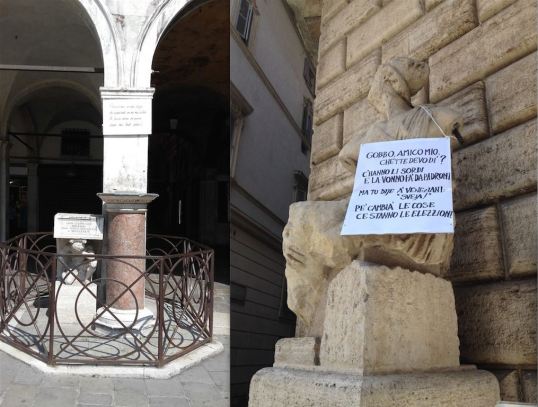
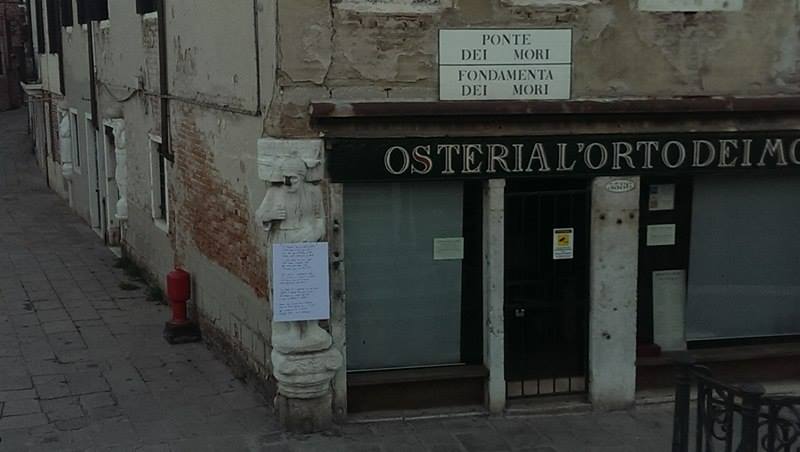
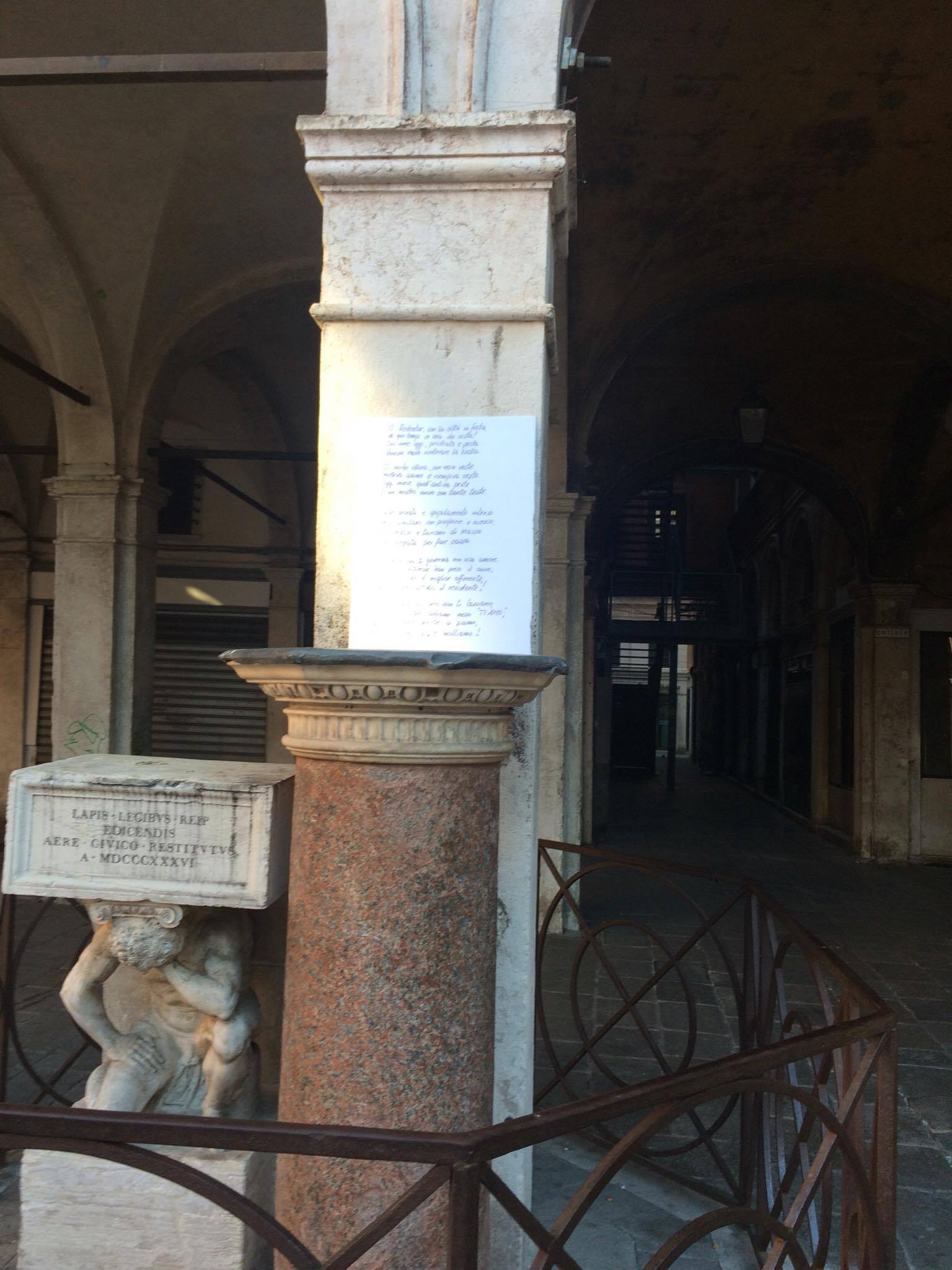
Il 2 luglio 2016, parlano pure le statue! Dopo secoli di silenzio, il gobbo di Rialto a Venezia e il Pasquino di Roma riprendono il dialogo a distanza interrotto ai tempi di Pietro l’Aretino:

2-lugliogobbo

2-luglio-2017-gobbo-e-pasquino

Sorpresa nella sorpresa: a mezzogiorno ritrova la parola la statua di Carlo Goldoni in campo San Bortolo, con un cartello di satira pungente che conserviamo fra le nostre “reliquie”, e simultaneamente parlano le statue di Daniele Manin e Niccolò Tommaseo, in campo Manin e in campo Santo Stefano, scambiandosi le loro impressioni sullo stato attuale della res publica:

Le nostre “volanti” guidate da anonimi eroi con piglio risorgimentale hanno fatto miracoli, quel giorno !!! Peccato non poterli ringraziare con nome e cognome: se non lo facciamo è per non metterli in imbarazzo ma il gruppo ha buona memoria e non dimentica.

7 luglio: #Veneziamiofuturo si appella all’UNESCO, con una lettera alla direttrice generale Irina Bokova.

7 juillet Lettera Il testo in discussione a Istanbul è quello che per primi avevamo diffuso e tradotto in italiano, il 3 luglio:

14 luglio (anniversario della presa della Bastiglia): nonostante i tentativi di rinvio e alla vigilia di un tentativo di colpo di Stato (l’UNESCO si riuniva in Turchia!) la Risoluzione viene adottata senza modifiche e occuperà le pagine dei giornali il giorno successivo; in stile “Radio Londra”, siamo noi i primi a darne notizia in tempo reale, sul nostro canale youtube:

Conclusa con successo la mobilitazione lampo (“flashmob”) del 2 luglio, incassata la risoluzione che a gran voce avevamo sollecitato all’UNESCO, avremmo potuto “staccare la spina” per qualche settimana e goderci la copiosa rassegna stampa, che sarebbe impossibile riprodurre qui per intero.

4-luglio-gazzettino

2017-unesco

.. e invece no:  il riposo non faceva per noi, in quel luglio caldissimo: 16 luglio 2016, seconda “mobilitazione lampo” coordinata da Nicola, Anna e Philippe, con il supporto tecnico di Cesco e Alessandra:

https://gruppo25aprile.org/tag/redentore-2016/

16 luglio 2016, “operazione Redentore”:

Col Redentor Venessia se stua” – diceva il vecchio adagio (“con la festa del Redentore Venezia si spegne”, nel senso che la gente parte in ferie).

Veramente? Nel caso del Gruppo25Aprile non è andata proprio cosi: la mobilitazione lampo #Veneziamiofuturo si avviava a diventare campagna di opinione, con incontri pubblici in tutti i sestieri (quello conclusivo si terrà il 20 gennaio): una scommessa mai tentata prima, nata ai giardini Papadopoli il 12 agosto; una scommessa che siamo riusciti a vincere, perché le promesse si mantengono e la parola data per noi è sacra, ma di questo parleremo nella prossima puntata (la terza parte di “2016, un anno in sintesi”).

Se tutto questo è stato possibile, è perché intorno all’idea iniziale si sono aggregate le migliori energie che sotto la cenere forse attendevano un evento catalizzatore, come un fuoco mai spento, attizzato anche dalla infelice dichiarazione di un Sindaco che aveva detto “il futuro di Venezia è a Mestre, dove c’è la gente che vive”.

#Veneziamiofuturo è stato uno scatto di reni corale che ha coinvolto più di 300 attivisti, e siamo solo all’inizio: la pagina facebook creata nelle settimane successive ha già superato i 3.500 iscritti e fra di loro ci sono sicuramente altre persone in grado di darci una mano alla prossima occasione, se lo vorranno:

https://www.facebook.com/Veneziamiofuturo-Venicemyfuture-1386457084717794/

Un grazie di cuore a tutte le persone che ci hanno creduto e ancora ci credono, senza distinzione di età, di religione e di condizione sociale.

rispetto-1

Per chi volesse leggere anche la prima parte:

2016, un anno in sintesi. Prima parte: gennaio – giugno

althea-1

#Veneziamiofuturo: viva viva el Redentor!

chiesa 2Dopo ogni epidemia, Venezia si rialzava come la fenice, perché disponeva di una classe dirigente lungimirante, che non sacrificava il #futuro ai profitti di breve termine.. per scongiurare altre epidemie di peste che falcidiavano la popolazione dimezzandola, i veneziani facevano voto di erigere una chiesa ed erano persone di parola, religiosi ma anche pragamatici: alla fine di ogni epidemia di peste, mandavano galee in ogni porto del mediterraneo con un messaggio molto semplice:

volete lavorare e vivere nella città più bella del mondo? a Venezia c’è lavoro per voi, a Venezia ci sono case per voi.. e la città si ripopolava, dopo ogni epidemia ritornava ad essere più bella e più forte e più ricca di prima.

OLYMPUS DIGITAL CAMERA

Alle maestranze specializzate (i futuri “arsenalotti”) Venezia metteva addirittura a disposizione le case, nel sestier di Castello che tuttora ospita il nostro arsenale, e nei dintorni dell’arsenale sono nate le nostre “vele”, quelle che avete visto in tutti i sestieri:

infografica-venezia-35x50-web

#Veneziamiofuturo nasce da una domanda impietosa, che tutti ci poniamo e richiede risposte indifferibili:

cosa abbiamo sbagliato, e dove abbiamo sbagliato, in questi anni? Dopo ogni epidemia di peste (da 143.000 a 98.000 abitanti, nel 1630) i nostri avi erano stati capaci di rialzarsi e attirare nuove energie, riportando in pochi anni questa città alla sua popolazione naturale. Di quale epidemia siamo malati, per essere scesi a 55.000 abitanti? Se togliamo la Giudecca che resiste, nei sestieri siamo già sotto quota 50.000. cosa ha fatto il sindaco in carica, per invertire la rotta, dopo aver promesso “30.000 nuovi residenti” in campagna elettorale? Con lui abbiamo perso altri 1.000 residenti, in un anno esatto.

La tradizione vuole che i veneziani affidassero i loro messaggi ai Potenti ad alcune statue, e oggi all’alba lo hanno fatto di nuovo:

rioba 4

Dopo secoli di silenzio, el Sior Rioba oggi all’alba ha parlato, e ha parlato anche il gobbo di Rialto:

gobbo 1e il genius loci si è espresso cosi:

AlbertoAlberti#Veneziamiofuturo è una dichiarazione di intenti, e non solo una dichiarazione di amore. #Veneziamiofuturo comincia oggi, nel giorno simbolico del Redentore:

“Venezia cara, non ti lasciamo

sulle tue pietre abbiamo messo “TI AMO”

Oggi e per sempre per te ci siamo.

Stringiti forte, non ti moliamo”.

#Veneziamiofuturo non va in vacanza: nelle prossime settimane lavorerà per voi, mettendo da parte steccati e barriere ideologiche, perché la nostra unica bussola è Venezia.

Appuntamento a settembre, per gli eventi che intendiamo organizzare coinvolgendo tutta la Città che amiamo.


Venezia e UNESCO: i primi commenti dei media online

In attesa della rassegna stampa “cartacea”, che si annuncia copiosa, rassegna degli articoli apparsi online:

http://corrieredelveneto.corriere.it/veneto/notizie/cronaca/2016/14-luglio-2016/venezia-l-ultimatum-dell-unesco-nessuna-strategia-tempo-scaduto-240680846330.shtml

http://www.ilgazzettino.it/nordest/venezia/unesco_venezia_ultimatum_rischio_declassamento-1856080.html

L’Unesco approva l’ultimatum su Venezia e laguna

http://nuovavenezia.gelocal.it/venezia/cronaca/2016/07/14/news/ultimatum-dell-uneso-affrontare-i-problemi-di-venezia-entro-febbraio-o-fuori-dai-siti-dell-umanita-1.13816312?ref=hfnvveea-1

http://www.veneziatoday.it/cronaca/risoluzione-unesco-venezia-14-luglio-2016.html

Venezia non diventi un villaggio turistico. Ultimatum dell’Unesco

..il primo servizio televisivo:

http://www.reteveneta.it/googlenews/2016-07-14-VENEZIATG-UNESCO-VENEZIA-A-FEBBRAIO-NELLA-BLACK-LIST.html

..e il nostro comunicato stampa, in versione youtube:

logo


Venezia e il “processo di Bisanzio” (Istanbul, 14 luglio 2016)

“l’Accusa” (relatore UNESCO):

Gioiello per il patrimonio mondiale, il sito comprende Venezia E la sua laguna. Visita ispettori svolta dal 13 al 18 ottobre 2015.

Rapporto ispettori inviato al governo italiano e al Comune per raccogliere commenti e osservazioni, il 9 giugno 2016. Nessun errore è stato contestato dalle autorità italiane.

Venezia corre un pericolo reale, dobbiamo agire rapidamente. Necessaria una nuova campagna “Salviamo Venezia” come quella avviata alla fine degli anni 60.

La “difesa” (ambasciatrice italiana presso l’UNESCO):

L’Italia ha già speso tanti soldi per Venezia.

Fidatevi di noi, guardate come abbiamo gestito il sito UNESCO di Pompei.

il 27 luglio adotteremo un piano nazionale per il turismo sostenibile.

Gli interventi “ad adiuvandum”

Europa Nostra, a nome di tutte le ONG aderenti, sollecita intervento immediato e senza proroghe da parte di UNESCO e UE. Chiede un “piano radicale che coinvolga la società civile per la più bella città del mondo”: “a radical plan with involvement of civil society for the most beautiful city in the world”.

Il verdetto:

“Si raccomanda pertanto allo Stato contraente (l’Italia) di attuare tutte le misure urgenti sottolineate nel rapporto di missione e di sottoporre alla Commissione del Patrimonio Mondiale un rapporto dettagliato sullo stato di conservazione entro il primo febbraio 2017 in modo tale che, nel caso in cui non siano stati realizzati miglioramenti sostanziali entro tale data, la Commissione valuterà l’iscrizione del sito (Venezia e la sua Laguna) nella Lista dei siti del Patrimonio dell’Umanità in Pericolo in occasione della sua 41a sessione nel 2017”.

Adottato, all’unanimità.

EugeniaMorpurgo

Il bailo:

L’intervento di Francesco Bandarin, nato a Venezia, alto funzionario UNESCO:

“There is a risk: Venice seems to have lost its capacity to define its future, and can become the pray of sectorial interests, be they called mass tourism, the harbour economy, infrastructures, boat and ship traffic, the exploitation of the natural environment.

A number fully epitomises the situation: last year, the city received over 25 million visitors. On an average  day in the spring or summer, you can have over 100,000 visitors, in a city that has now around 50,000 registered residents.

Is this our fate? Is Venice doomed to become a tourist village?  Surely, the population of Venice has declined to historical minima, and the local powers are unable to cope with the new challenges.  Surely, the global trends, climatic, economic, demographic, could make the situation even worse in the future”.


Venezia/Bisanzio, 14 luglio 2016

Foto: Eugenia Morpurgo

Trascrizione e sintesi: Carlo Beltrame e Marco Gasparinetti


La résolution de l’Unesco : un tournant historique pour Venise et sa Lagune

Communiqué de presse : 
La résolution de l’Unesco adoptée à l’unanimité aujourd’hui 14 Juillet  2016 par l’Unesco, crée un environnement comparable à celui qui a entraîné l’adoption de la première Loi spéciale de 1973 sur Venise.
Le groupe 25Aprile se félicite et salue cette résolution de l’Unesco qui va finalement créer la pression morale nécessaire pour remuer les eaux stagnantes de l’administration locale et nationale.
Le groupe 25 Aprile lance un appel au gouvernement national, dans la mesure où l’Italie est signataire de la Convention et que c’est à l’Italie de répondre à tout manquement avant le délai fixé par l’Unesco (février 2017) afin d’éviter la honte que représenterait l’inscription de Venise sur la liste des sites du patrimoine mondial de l’humanité en danger : une honte sans précédent dans l’histoire de notre pays.
Le groupe 25 Aprile souligne comme cela a été fait aujourd’hui lors de la retransmission en mondiovision de la conférence ( en webstreaming) que l’Unesco a parlé du risque pour Venise de devenir un simple “village touristique” et d’une administration locale impuissante (“local powers unable to cope”) face à la situation actuelle. De par notre propre expérience, nous ne pouvons que confirmer cette affirmation grave mais véridique.
Le groupe 25 Aprile se concertera immédiatement avec les autres associations qui participent à la campagne “#Veneziamiofuturo” pour réclamer un entretien urgent auprès du gouvernement italien, lors duquel seront présentées des propositions concrètes nées de la connaissance directe du milieu et de ses habitants et non de calculs économiques ou politiques à court terme.
Venise, le 14 juillet 2016
Le porte parole
Marco Gasparinetti
UNESCO

Navigazione articolo